
Lockport Resident Record Coverage
Official sources confirm different parts of a Lockport resident question. The Niagara County assessment roll connects a person or prior owner to a parcel account, not necessarily to current occupancy. The voter tool is an individual registration check. Court tools identify indexed matters, while an estate file can identify a proceeding. Vital records answer event questions only when the requester meets the applicable rules. Start with the record that directly matches the fact being checked, then preserve the search date and jurisdiction with the result.
| Record | What It Confirms | Where | Access |
|---|---|---|---|
| Assessment roll | Parcel, assessed owner, mailing address, class, and deed book/page | Niagara PROS-GAR | Free public search; municipality matters |
| Voter status | Registration and polling-place style information | NYS voter lookup | Individual lookup; confidential voters are protected |
| Court index | Party, court, case number, status, and filing-year fields | NYS eCourts | Free index; clerk file is separate |
| Estate proceeding | Estate party or filing information | WebSurrogate | Older unrestricted files use courthouse computers |
| Vital event | Birth, death, or marriage event when eligibility is met | Lockport City Clerk or NYS DOH | Confidentiality and request rules apply |
For a current parcel question, begin with the owner or street controls in PROS-GAR. For a case question, begin in the relevant eCourts index. A historical household question belongs with the library’s directories and newspapers. That division keeps the search from turning a name match into a conclusion.
Lockport Name Record Context
Same-name results are leads, not identity proof. Compare a surname, first name, middle initial, variant spelling, municipality, and source date before moving to a second record. In the 2025 City of Lockport assessment roll, the parcel situs and the owner mailing address can differ. A person listed for mail may not occupy that parcel. Likewise, a voter, property, or court name match does not establish current residence, title, or a court outcome.
The assessment record has useful anchors: SBL, or tax-map parcel number, property class, situs, owner or mailing address, assessment values, school district, and deed book/page. Use the SBL to keep a name tied to one parcel. When an older address is involved, the Lockport city directory collections offer dated print and microfilm entries from 1856 to the present, rather than a claim about present-day residence.
Note: Record the exact date and municipality whenever a Lockport name appears, because City and Town custodians keep separate records.
Lockport Court Record Search
WebCivil Local is a free party-search index for local civil courts. It can narrow a search through party name, attorney, judge, party role, court, case type, filing year, status, and future-appearance controls. Choose the person’s role and court when those details are known. The index can produce HTML or PDF output, but it does not promise full pleadings or a complete person history.
| Visible court field | How it helps verify a result |
|---|---|
| Party name and role | Distinguishes plaintiff, defendant, or either-party searches. |
| Case number and court | Gives the clerk a specific file to locate. |
| Case type and filing year | Separates similar names and different matters. |
| Status and future appearance | Describes index status, not an adjudicated result. |
| Attorney or judge fields | Provides additional index context when shown. |
The WebCivil Local search screen shows the party and case filters used to check a Lockport court result.
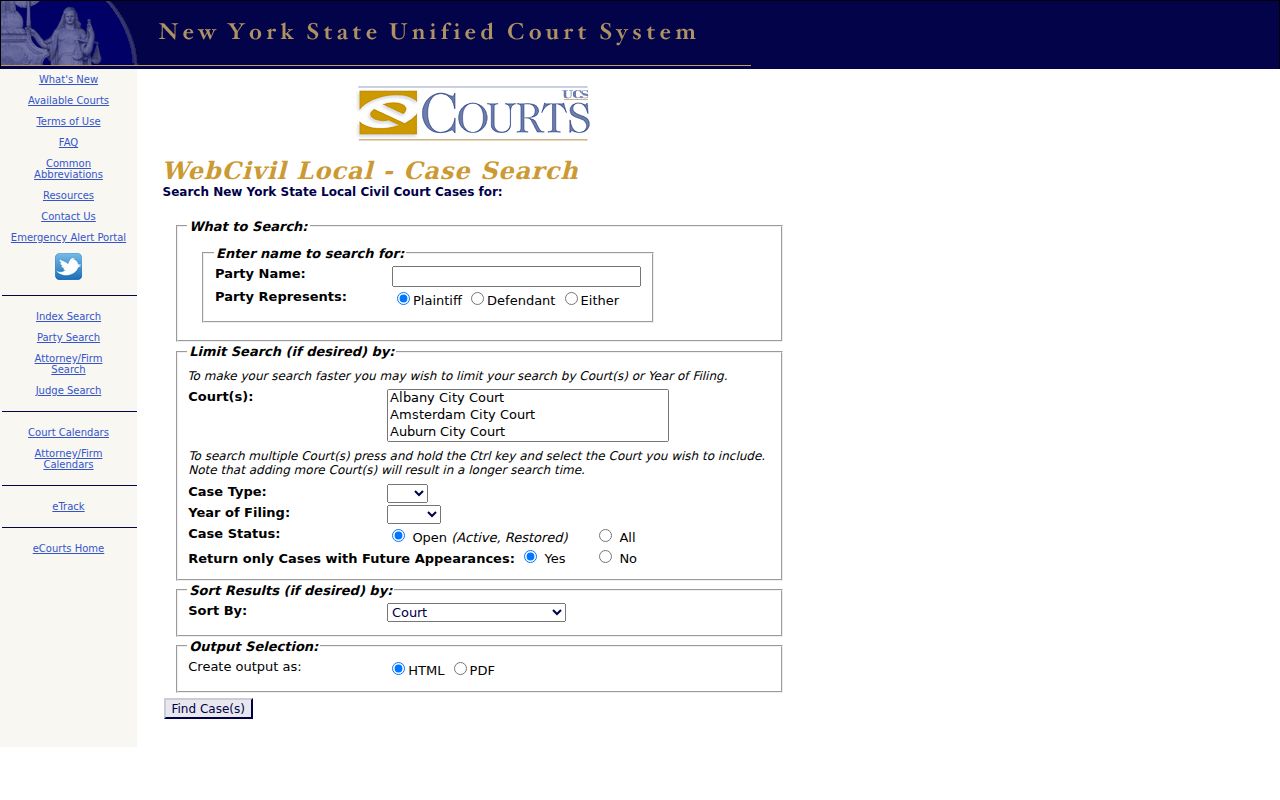
Use a case number, court, filing year, and party role together before seeking the underlying file. Sealed, confidential, victim, and protected personal information may be absent, and a docket is not proof of a conviction unless the disposition says so.
Lockport Voter Lookup Check
The NYS voter lookup asks for county, last name, first name, date of birth, and ZIP Code. It is designed for an individual registration and polling-place style check. A ZIP is only an input. It is not a ward, election district, municipality, or parcel boundary. No county-run public portal for a street-wide name search was located, so a broad address list should not be inferred from the individual form.
The New York voter lookup form displays the county, name, date-of-birth, and ZIP controls relevant to an individual registration query.
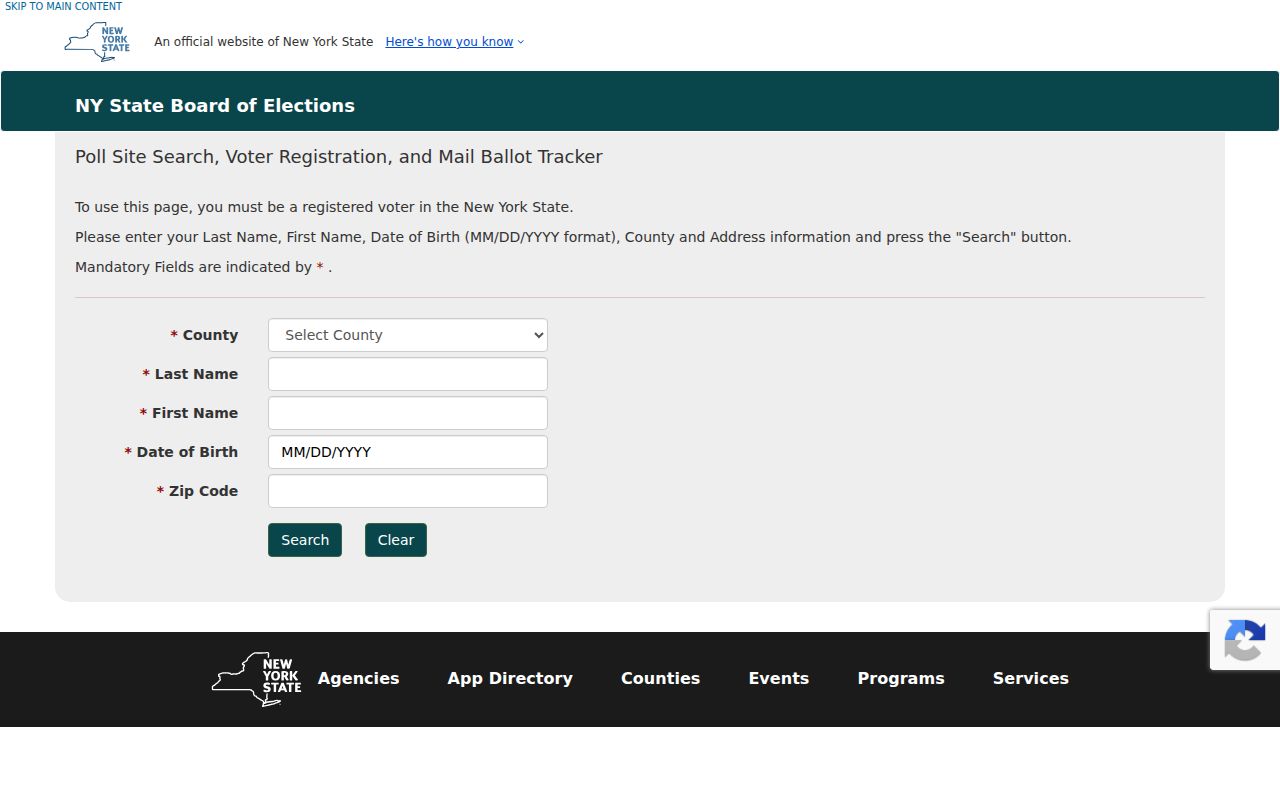
The Niagara County Board of Elections also provides local polling and map information. Public-list requests follow Election Law and FOIL procedures, and statewide voter-data requests must state an elections purpose. Confidential registration under Election Law §5-508 is intentionally not interchangeable with an ordinary public voter list.
Lockport Estate Record Routes
An estate question requires a probate source, not a general name search. WebSurrogate offers Name Search, File Search, Old Index Search, Index Book Pages, and Will Search for estate proceedings and filings. Documents filed on or after February 19, 2014 are online. Earlier unrestricted files can be viewed on courthouse public computers. Safekeeping wills are not public, and confidential personal information remains restricted.
The WebSurrogate search portal is the starting screen for a named estate inquiry.
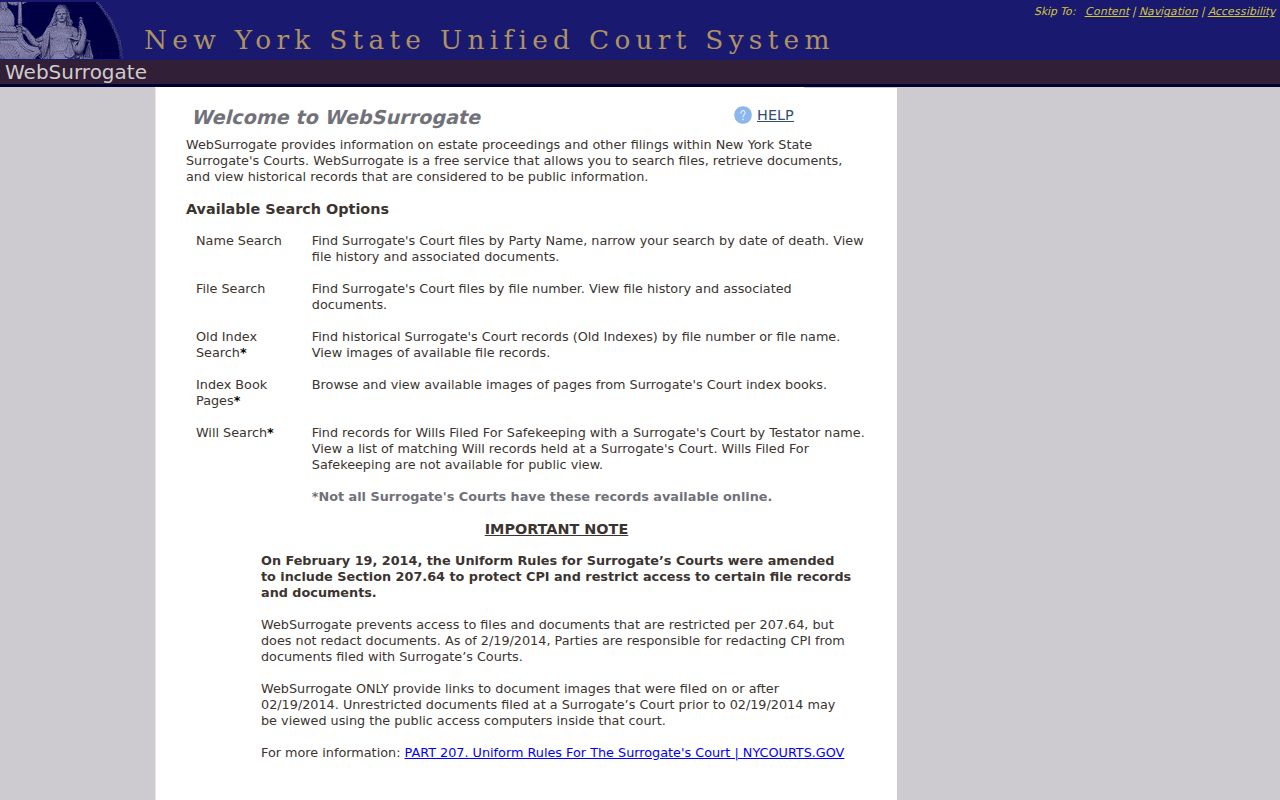
Niagara County Surrogate’s Court is at 175 Hawley Street. The online filing date is a document-access boundary, not a statement that older estate material does not exist. A file number and the correct court make an in-person request more precise.
Note: Probate materials can identify an estate proceeding, but the file must be read for its own access restrictions and dates.
Verify a Lockport Resident
A one-person verification process should move from a specific claim to the custodian that records it. Property data can anchor a parcel, then a deed book/page can lead to the County Clerk. Court data can identify a matter, then the clerk can supply the original file when access permits. Keep each result in its own lane rather than combining unrelated personal fields.
- Normalize the name with known spelling variants and a middle initial where available.
- Search PROS-GAR by owner or address after selecting City of Lockport or Town of Lockport, then record the situs, SBL, class, owner name, mailing address, and deed book/page.
- Use the book/page or party name with SearchIQS, the County Clerk’s public computers, or a clerk document request. A recorded deed is stronger title evidence than an assessment roll, but it does not prove occupancy.
- Check the appropriate court index by name, role, court, year, and case status. Request a clerk file or certificate only when that record is needed and available.
- Docket
- A court’s indexed case record, usually showing identifying fields and status rather than every document.
- Index versus image
- An index points to a record; an image is the document itself and may be gated, unavailable, or redacted.
- Certified copy
- A copy issued by the custodian with official certification, subject to that office’s access and fee rules.
Lockport Vital Record Limits
Vital records are not a general name-search tool. The Lockport City Clerk holds city birth and death records and marriages where the license was obtained there. The state route is useful when the municipality is unknown or statewide certification is appropriate. City and Town records remain separate. For genealogy, the City Clerk form states local records begin in 1880, while the NYS Department of Health states registration outside New York City began in 1881. Those are custodian-specific statements and should not be merged into one date.
New York’s genealogy route restricts birth records for 75 years unless the person is known deceased, death records for 50 years, and marriage records for 50 years when both spouses are deceased. Direct-line descendants may use a waiver with proof. The Lockport genealogy service also uses those periods and states an $11 fee per record. Standard certified copies have narrower eligibility, identification, notarization, and payment requirements.
Library newspaper microfilm and the obituary index can help establish a death date before a vital request. They do not replace the registrar. FOIL does not override vital-record confidentiality.
Lockport License Record Check
A credential check can confirm a professional status, not a residence. NYSED Office of the Professions verification searches one profession at a time. It accepts at least three letters of a last name followed by a space and first name, or a complete six-digit license number. Results can show licensure date, registration status, location, and discipline summaries since 1994. Read each displayed location as an official result field, not an inference about a home address.
The NYSED verification screen illustrates the profession-specific route used for a public credential question. Use it to look up a resident only when that credential is the specific fact being checked.
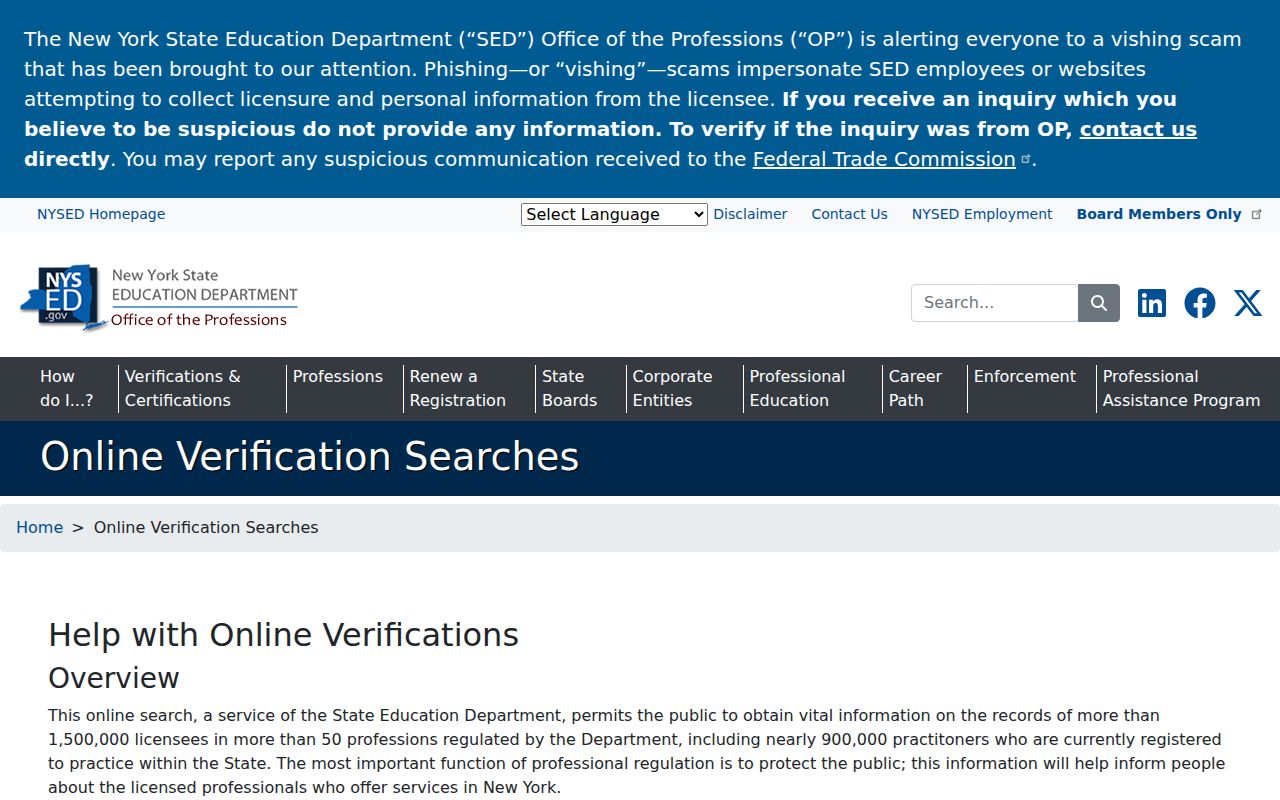
The NY Department of State active-license tool separately accepts last and first name, license type, county, city, and ZIP. It omits protected residence addresses. A credential result should remain limited to the official fact the regulator displays.
Note: A license, business filing, or service address can document a regulated record without showing where a person lives.
Lockport Resident Lookup Limits
Intentional gaps are part of the Lockport records system. The NYS Address Confidentiality Program uses a substitute Albany mailing address for qualifying participants and requires agencies to protect the actual location. Confidential voters use a separate process through the Board of Elections. Court indexes can omit sealed or confidential matters, County Clerk criminal requests redact victim, medical, and personal information, and recent vital records remain restricted. An absent result means only that the source did not return a result under that search.
Lawful personal use. Use Lockport resident records for personal, lawful research and keep sensitive details limited to what the question requires. Do not use any result to stalk, harass, intimidate, or harm another person.
New York Freedom of Information Law, Public Officers Law Article 6, is a fallback for existing agency records that can be reasonably described. Agencies generally grant, deny, or acknowledge a written request within five business days, but exemptions still apply. Confirm a suspicious link through the custodian’s official domain: Niagara County’s 2024 move to a .gov domain was specifically presented as an authenticity signal.