
Lockport City Directory Holdings
The Lockport Public Library Local History Room reports Lockport City Directories from 1856 to the present in print and microfilm. That shelf is the primary local source for tying a printed address to an occupant or business in a particular year. The library does not publish a verified publisher-by-year inventory, so check the title page of the volume in hand rather than assigning a publisher from memory. It also does not identify a separate, complete reverse-directory run in its official inventory. A street section may appear in an individual volume, but it should be confirmed before relying on it.
| Collection | Years | Where Held | Access |
|---|---|---|---|
| Lockport City Directories | 1856-present | Lockport Public Library Local History Room | Print and microfilm while the library is open |
| U.S. Niagara County Census | 1820-1930, except 1890 | Lockport Public Library | Microfilm |
| New York State Niagara County Census | 1855, 1865, 1875 | Lockport Public Library | Microfilm and printed index |
| Lockport High School yearbooks | 1897-present | Lockport Public Library | Print volumes |
| DeSales Catholic High School yearbooks | 1950-1989 | Lockport Public Library | Print volumes |
No official digitized Lockport city-directory series was located. The library describes physical print and microfilm holdings, so an online historical book should not be presented as an annual directory replacement. The 1878, 1892, and 1897 county histories are useful background books, but they are not the same kind of year-by-year address source.
Lockport Directory Room Access
The Local History Room is on the third floor of the library at 23 East Avenue, Lockport, NY 14094. The library lists hours of Monday through Thursday from 9 AM to 8 PM and Friday from 9 AM to 5 PM; it lists Saturday and Sunday as closed. Call 716-433-5935 before a special trip, especially when a particular reel or volume matters. The room is an in-person route, not a remote directory-search service. Library staff can check standard local sources and may look for an obituary when given a death date, but they do not promise unlimited census or surname research.
Two public microfilm scanners operate first come, first served. When others are waiting, use is limited to 60 minutes. A library card is needed for log-in, and the library says visitors from outside the area can obtain guest passes. Prints cost $0.15 per page; scans can be saved to a USB drive or sent by email. Bring the directory year, a spelling variant, and an address or neighborhood note. That preparation makes the limited scanner time much more useful.
Reading Lockport City Directory Entries
Begin in the alphabetical name section and copy an entry exactly as it appears. A listing can include a surname, initials, a street address, a business or occupation field, and a spouse or household notation. The best evidence is the combination of the volume year, page, spelling, address, and any abbreviation. An entry records a reported presence or association near publication, not a confirmed title interest or a statement about who occupies the address today. Check the surrounding names as well, since relatives, boarders, and business partners can make an ambiguous entry easier to distinguish.
| Printed name | Copy surname, initials, and spelling exactly, including variant forms. |
|---|---|
| Street address | Record the number and street as printed, then compare it with the volume year. |
| Business field | Note an occupation or business description only when the entry prints one. |
| Household notation | Preserve any spouse, widow, boarder, or other household wording instead of expanding it by guesswork. |
| Volume reference | Keep the directory year and page with the transcription for later verification. |
- Criss-cross directory
- A directory arranged by street and number rather than alphabetically by name. Lockport has no official published inventory confirming a separate run, so inspect the individual volume first.
- Householder index
- A name list intended to point to the household or address. It can be useful, but it does not establish ownership.
- Abbreviation key
- The volume’s own explanation of shortened words and marks. Read it before expanding an entry in a research note.
When a mark is unclear, preserve it in the transcription and return to the volume’s key. A cautious note is more useful than a polished but unsupported expansion.
Lockport City Directory Gap Checks
When a name appears in one directory and not the next, local newspaper microfilm can supply context. The library holds the Lockport Daily Advertiser & Democrat for August 2, 1858 through December 31, 1859; the Lockport Daily Union/Sun for July 11, 1866 through December 30, 1899; the Niagara Democrat for January 6, 1883 through December 27, 1884; and the Lockport Union Sun & Journal from October 1899 to the present. Gaps are possible, and the older microfilm is not generally indexed.
The Union Sun & Journal obituary index covers only 1900-1903 and 2007-2011. A failed index search is not proof that an obituary or notice does not exist. Search dates around a move, marriage, death, business change, or legal notice, and then use the microfilm. New York State Historic Newspapers is another useful route, but it should be treated as a separate digital collection rather than as a substitute for the library’s annual city-directory shelf.
Note: The library records specific publication gaps, so narrow a newspaper search by date and edition before treating silence as a missing household event.
Lockport City Directory Census Pairing
City directories fill the long spaces between census years. The library’s federal Niagara County census microfilm runs from 1820 through 1930, except for the lost 1890 federal schedule, and it lists online access for 1940 and 1950. Its New York State census holdings cover 1855, 1865, and 1875 with microfilm and a printed index. Read a directory entry beside the nearest census rather than forcing one source to answer every question. The directory can supply an address or business description, while the census may show a household composition for its enumeration date.
- Write down the directory year, page, name spelling, and address before changing sources.
- Choose the closest federal or state census year and search the surname with initials and spelling variants in mind.
- Compare household members, street information, and age patterns without assuming a similar name is the same person.
- Use the next directory volume to test whether the address or household changed after the census date.
For a death clue, pair a late directory appearance with the newspaper route or an eligible vital-record channel. For a school-age person, the Lockport High School yearbooks from 1897 forward and DeSales yearbooks from 1950 through 1989 can add a time-specific community reference. Neither kind of companion source should be used as a present-day address claim.
Lockport City Directory Building Evidence
The Polster Photographs of Lockport collection on NY Heritage can help connect a sparse directory address to a streetscape. Edwin Polster’s work is especially strong for downtown, canal, school, church, civic, industrial, and business scenes from the 1940s through the 1960s. A photograph can support a building-history note or help identify a block, but it cannot by itself establish who lived or owned property there.
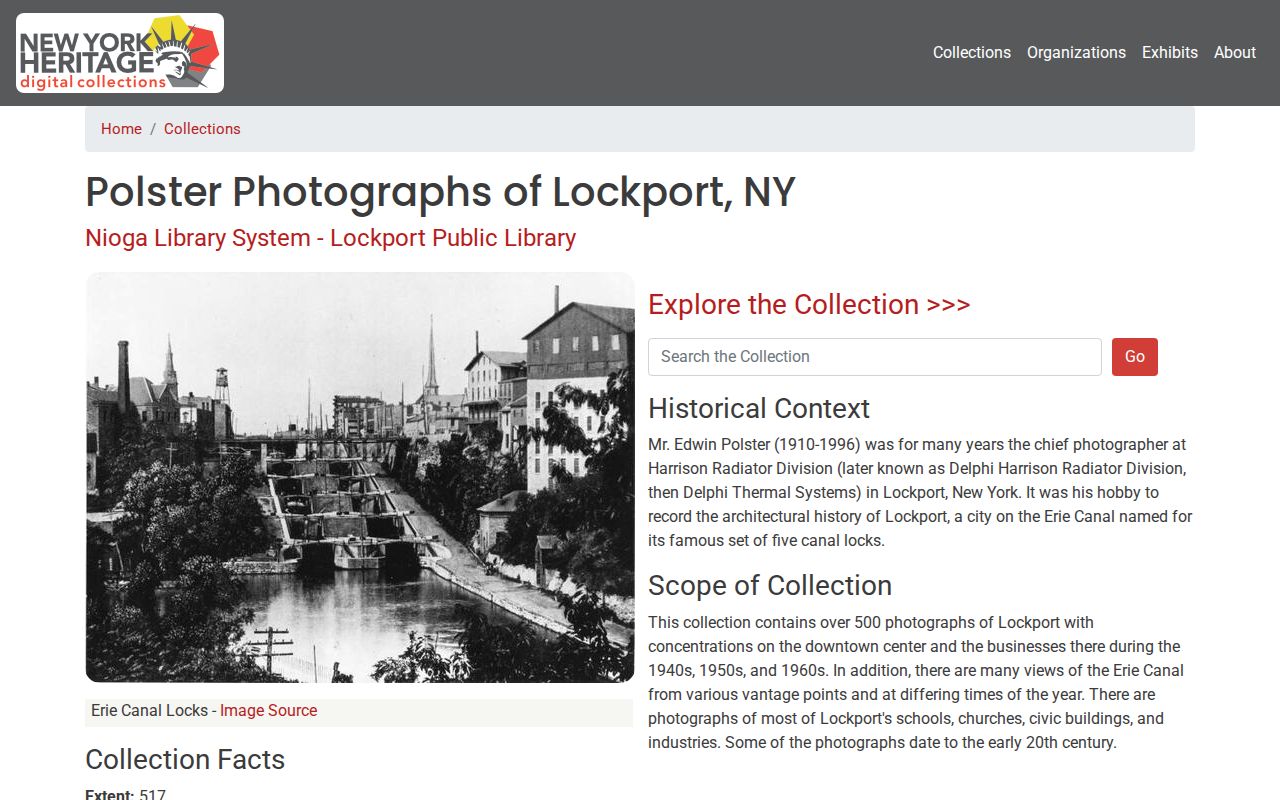
Use the image collection beside the printed directory year, not instead of it. The library says its physical Polster photographs are organized by subject and sequential number with a printed index near the collection, giving a second route when an online search result is too broad.
The Library of Congress 1903 Lockport Sanborn map set has 28 sheets and adds building footprints, neighboring structures, and historic uses. It is especially helpful where an old address number does not line up neatly with a current parcel label.
Lockport City Directory Jurisdictions
Lockport is both a city and a county-seat location, and nearby Town of Lockport records are not interchangeable with City of Lockport records. The City Clerk’s genealogy material specifically warns that City and Town records are separate. Preserve the jurisdiction printed on the directory, census, deed, or vital source instead of changing it to a modern city label. This becomes important in early research because Lockport was incorporated as Niagara County’s first official city in 1865. Earlier material may use village, town, or county language.
| Milestone | Lockport record context |
|---|---|
| 1816 | Canal-route planning began, a useful early context for the place names that appear before city incorporation. |
| 1822 | Lockport became the county seat, placing county-level records in the local records geography. |
| 1865 | Lockport was incorporated as Niagara County’s first official city, so earlier records may use town, village, or county wording. |
| 1918-1940 | The County Clerk’s converted grantor/grantee and deed-volume material creates a bridge for property research alongside directory years. |
| Circa 1941 | IQS states deed indexing and imaging coverage from this approximate point, subject to its subscription and access limits. |
The City of Lockport history places the canal route in 1816, county-seat status in 1822, the Flight of Five work in 1823, and incorporation in 1865. Those milestones provide context for how a place was described, but they do not prove a particular household’s address. A careful research log should retain the repository, year, page or reel, jurisdiction label, and whether the source was an index, image, transcription, or narrative.
Trace Lockport City Directories
Tracing a household works best when each annual entry is treated as one dated observation. Start with a recent or confirmed address, then move through the newest available printed directory and work backward. Test initials, widows or widowers, maiden and prior names where a reliable source supplies them, and street-suffix changes. When a person drops out, examine the volumes immediately before and after the gap before deciding that a move or death occurred. The same address may appear under a business, a household, or a changed number.
- Find the surname or address in one Lockport City Directory and save the year, page, and exact wording.
- Check adjacent directory years for a new address, altered name form, or a different household notation.
- Pair the interval with a federal or state census, then compare the household without treating a same-name match as conclusive.
- Use newspaper microfilm for a dated event, and the library’s obituary route when a death date is known.
- For a property question, carry the parcel’s legal description or deed book/page to the County Clerk rather than relying on a directory listing.
The County Clerk’s land records supply a different layer. SearchIQS documents are subscription-gated, while courthouse public computers, paper indexes, archival microfilm, and document requests remain fallback channels. Deed coverage is stated as circa 1941 in IQS, with a 1918-1940 conversion of 34 grantor/grantee index books and 280 deed volumes linked to Infodex. That bridge helps place a directory address in a property timeline without claiming that older deed images are freely available online.
Lockport City Directory Partners
The Niagara County Genealogical Society is at 215 Niagara Street, second floor. Its site describes an all-volunteer library with more than 2,000 books and a members-only collection of more than 10,000 digitized records. Confirm visitor and membership conditions before counting on an in-person visit. The organization is a useful companion for local context, but its collection is not described as an unrestricted public name-search database.

Its location near the local-history institutions makes it practical to take a directory citation, question, or family spelling variant to a second local repository after checking the library volume.
The Niagara County Historical Society and History Center, also at 215 Niagara Street, includes the History Center, Erie Canal Discovery Center, and Bond/Hawley House. Its local history, ephemera, and canal materials can explain the setting around an address or business listing.
Historical-society material is most persuasive when it is cited with the directory year and page that prompted the question. It adds context to an entry without turning a contextual source into a household roster.
Limits of Lockport City Directories
A city directory is a dated publication, not a complete resident roll or title record. It may omit people, use initials, reflect a business address, or preserve an older number. Never infer current occupancy, ownership, or a person’s identity from a single listing. Use the City and Town distinction, compare the source date, and retain the uncertainty where the record is thin. Official sources also show no verified full digitized directory run, no confirmed citywide renumbering project, and no official inventory establishing a separate reverse-directory series.
When the question becomes a modern parcel issue, use the address-focused route on the Lockport street address directory. For historical household work, the stronger sequence remains directory volume, census or newspaper context, and an appropriate custodian record when needed. That sequence keeps the annual directory in its proper role: a clear, useful clue that still needs comparison.
Note: A directory match supports historical presence near its publication date, but it does not prove present residence, occupancy, title, or identity.